

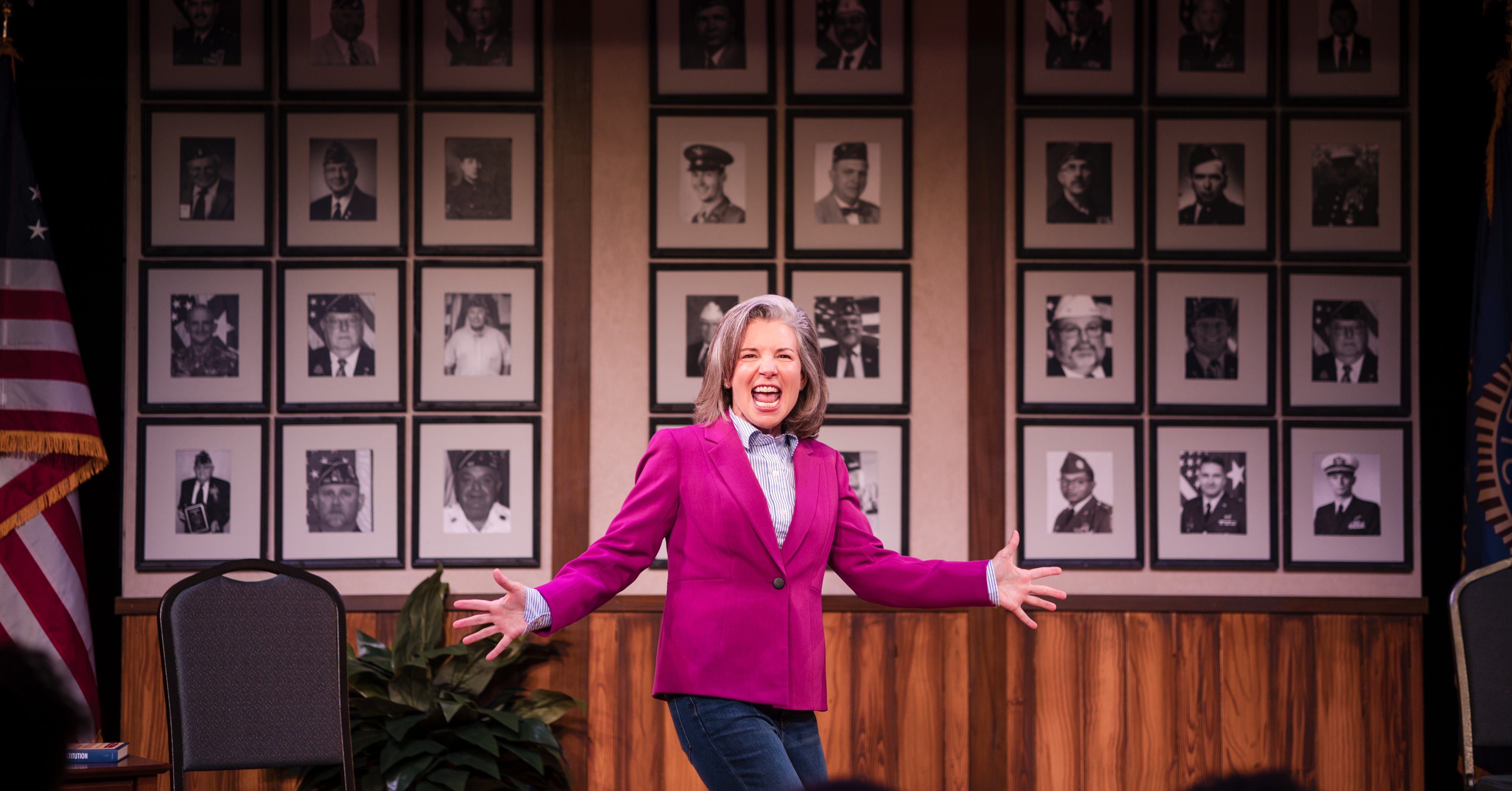
Since its premiere nearly a decade ago, What the Constitution Means to Me—a Pulitzer Prize finalist—has taken the theatrical world by storm, breathing new life into our Constitution by imagining how it will shape the next generation of Americans. As a teenager, playwright Heidi Schreck earned her college tuition by winning Constitutional debate competitions across the country. In this play, which opens tonight at The Rep as part of the Steve Woolf Studio Series, Schreck revisits her fifteen-year-old self to trace the profound relationship between four generations of women and the lasting impact of the document that shaped their journey.
The play first premiered in 2017 before its limited Broadway run in 2019, starring Schreck as herself. Over the course of its development, Schreck leaned on her own memories from her teenage years, but also did a lot of research into the impact and legacy of our Constitution and the laws of our land. Below you will find a list of books, articles, speeches, and other resources that were used in the creation of What the Constitution Means to Me, provided by Samuel French in the published script.
Disclaimer: This is by no means a list of required reading in order to see the play, but a list of additional works that audiences may use if they wish to dig deeper into the themes and ideas presented in Schreck’s work.
BOOKS
About Abortion: Terminating Pregnancy in Twenty-First-Century America, by Carol Sanger (The Belknap Press of Harvard University Press, 2017)
African Americans and the Living Constitution, edited by John Hope Franklin and Genna Rae McNeil (Smithsonian, 1995)
All the Single Ladies: Unmarried Women and the Rise of an Independent Nation, by Rebecca Traister (Simon & Schuster, 2016)
Black Resistance/White Law: A History of Constitutional Racism in America, by Mary Frances Berry (Penguin, 1971, 1994)
The Conduct of Life, by Maria Irene Fornes (Plays: Maria Irene Fornes, PAJ Publications, 2001)
The Constitution of the Czech Republic (1992)
The Constitution of the Republic of South Africa (1996)
Equal Means Equal: Why the Time for an Equal Rights Amendment Is Now, by Jessica Neuwirth (The New Press, 2015)
Fault Lines in the Constitution: The Framers, Their Fights, and the Flaws That Affect Us Today, by Cynthia Levinson and Sanford Levinson (Peachtree Publishing Company, 2017)
The Invisible Constitution, by Laurence H. Tribe (Oxford University Press, 2008)
Men Explain Things to Me, by Rebecca Solnit (Haymarket Books, 2014)
My Own Words, by Ruth Bader Ginsburg with Mary Hartnett and Wendy W. Williams (Simon & Schuster, 2016)
Notorious RBG: The Life and Times of Ruth Bader Ginsburg, by Irin Carmon and Shana Knizhnik (HarperCollins Publishers, 2015)
The Race of the Ark Tattoo, by W. David Hancock (a play, unpublished, 1998)
Retained by the People: The “Silent” Ninth Amendment and the Constitutional Rights Americans Don’t Know They Have, by Daniel A. Farber (Basic Books, 2007)
Song in a Weary Throat: Memoir of an American Pilgrimage, by Pauli Murray (Liveright Publishing Corporation of W. W. Norton & Company, 1987, 2018)
Trauma and Recovery: The Aftermath of Violence – From Domestic Abuse to Political Terror, by Judith Herman, M.D. (Basic Books, 1992, 2015)
2.5 Minute Ride, by Lisa Kron (Theatre Communications Group, 2000)
The Universal Declaration of Human Rights (United Nations, 1948)
The Warren Court and American Politics, by Lucas A. Powe, Jr. (The Belknap Press of Harvard University Press, 2002)
Wild Bill: The Legend and Life of William O. Douglas (America’s Most Controversial Supreme Court Justice), by Bruce Allen Murphy (Random House, 2003)
Women in Pacific Northwest History, edited by Karen J. Blair (University of Washington Press, 2001)
ARTICLES
“The Death of the Fourteenth Amendment: Castle Rock and Its Progeny,” by G. Kristian Miccio (William & Mary Journal of Race, Gender, and Social Justice; Volume 17 [2010–2011], Issue 2, Article 2, William & Mary Journal of Women and the Law; February 2011)
“To Have and Hold: Reproduction, Marriage, and the Constitution,” by Jill Lepore (New Yorker, May 18, 2015 and May 25, 2015 Dept. of Justice Issue)
“U.S. in Top 10 Most Dangerous Countries for Women, Report Finds,” by David Brennan (Newsweek, June 26, 2018)
SPEECHES
“The Bicentennial Speech,” by Justice Thurgood Marshall (delivered in Maui, Hawaii on May 6, 1987, as part of the constitutional bicentennial celebration at the Annual Seminar of the San Francisco Patent and Trademark Law Association)
OTHER
Much of the research for this play was done with the help of oyez.org, a free law project supported through Cornell’s Legal Information Institute, justia.com, and Chicago-Kent College of Law. Oyez is a terrific website that makes recordings of Supreme Court cases accessible to the public for free.
The Rep’s production of What the Constitution Means to Me runs until November 15, 2026 in the Emerson Studio Theatre.
The Rep: Official Website | Facebook | Instagram | YouTube